

Yes, a padel club can be a good investment, but not automatically.
Whether your project pays off comes down to 4 things:
– how many hours you sell per court (occupancy)
– what price per hour
– how much you invest up front
– how much extra you earn from coaching, events and food and drinks.
This guide sets out the latest market figures, explains how a padel club makes its money and gives you a simple formula to work out break-even for your own site.
The short answer: when padel is a good investment
| Factor | What it means | What to watch |
|---|---|---|
| Occupancy | Hours sold per court each week | Evenings and weekends fill quickly. The real difference comes from filling off-peak slots with coaching, leagues and corporate bookings. |
| Price per hour | Your peak and off-peak rates | Depends on your local market, indoor or outdoor, and how premium the venue feels. |
| Investment | Courts, groundworks, building or canopy, lighting, fit-out | The court line you choose affects both your build cost and the price you can charge. |
| Secondary revenue | Food and drink, pro shop, coaching, events, memberships | For many clubs, this is what turns a slow payback into a fast one. |
Check also:
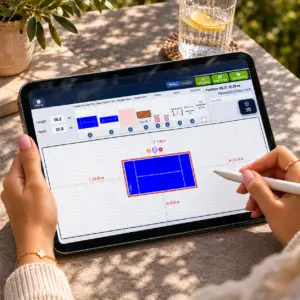
The profit calculator is an interactive tool helps you estimate daily, monthly, and annual turnover from court rentals by adjusting key variables. Simply enter details like daily operating hours, average rental price, occupancy rate, and the number of available courts to see how each factor influences potential earnings. You can also select your preferred currency for results.
The padel market in numbers
The Playtomic Global Padel Report 2026 shows padel is still growing worldwide:
| Indicator | Figure | What it means for your investment |
|---|---|---|
| Padel courts worldwide | 58,334 (2025) | The sport keeps spreading, well beyond its original core markets. |
| New courts in 2025 | 7,898 (+16%) | New venues are opening fast. Check what’s planned near your site. |
| New clubs in 2025 | 4,969 | With more clubs, location, service and a clear offer matter more. |
| Growth since 2016 | Around 6x more courts | Not a short-term trend, but steady growth over many years. |
| Players worldwide | More than 19.4 million | A large player base for bookings, coaching and leagues. You still need to check local demand. |
Source: Playtomic Global Padel Report 2026, pp. 7 and 24.
Global growth is a good starting point, but it doesn’t guarantee that any single club will be profitable. A viable project needs a local demand check, realistic occupancy assumptions, the right site and a clear forecast of running costs.
Why the UK and Ireland are attractive now
The report groups the UK, Germany and Ireland as “Hotspot” markets: demand is growing fast, especially in cities, and clubs with a strong offer can charge higher prices (pp. 8 and 15). In the UK in particular, demand is ahead of supply:

Padel Courts are busy
Average peak-hour occupancy at major UK clubs is around 85% (p. 16).

Players struggle to book
About half of UK players say they find it hard to get a court at peak times (p. 16).

Operators are expanding
Chains are opening large indoor venues to meet that demand (p. 16).

Ireland is growing from a small base
It was one of the notable contributors to new courts in the rest of Europe in 2025 (p. 7).
For your plan, this means demand is there in many UK cities. The challenge is securing the right site and getting it approved.
How a padel club makes money
A court’s revenue comes down to opening hours × occupancy × price per hour (Playtomic Global Padel Report 2026, p. 29). That’s why clubs with the same number of courts can perform very differently.
Court bookings are the core
On average they account for 68% of booking value, with open matches, academies and leagues the main extras (p. 33).
The gap between clubs is large
Globally, top-performing clubs earn around €3,531 in booking revenue per court per month, against around €736 for the weakest: roughly five times more (p. 35). No single lever explains it. Top clubs do better across occupancy, pricing, the mix of activities, online booking and the quality of the venue.
Top clubs sell more than court time
About 9 in 10 offer experiences beyond the court, such as social events, group coaching or fitness (p. 37). UK clubs in particular are building dedicated fitness communities around padel (p. 39).
For a full list of revenue streams, read Making Money with Padel.
Padel vs tennis: more revenue from the same space
Two or three padel courts on one tennis court
A padel court measures 20 × 10 m, so a single tennis court can usually fit two or three padel courts. That means more bookable hours from the same footprint. Check how many courts fit your space with our Padel Floor Planner or see floor plan examples for padel clubs.
Four players per booking
Padel is almost always played as doubles. Four players per slot means more spend at the bar and pro shop, and more people for coaching, leagues and tournaments.
Lower maintenance
Tennis courts, especially clay, need constant upkeep. A high-quality padel court mainly needs regular cleaning of the glass walls and the quartz sand redistributed every two to three months.
Work out your break-even
Two simple calculations will tell you whether your project stacks up:
Break-even formulas
Monthly court revenue = number of courts × hours sold per court per week × price per hour × 4.3
Break-even in months = total investment ÷ (monthly revenue − monthly running costs)
Use cautious occupancy assumptions and add secondary revenue separately, so you can see how much your project depends on food and drink, coaching and events. For a quick estimate, try our Profit Calculator. For the full picture, use our Business Plan for Padel.
Basic, Panoramic PRO, PREMIUM-Line: which line fits your business case?
The right court depends on where it stands and how you plan to earn money from it. Here is how our three lines compare.
| Line | Setting | Best for | Why it pays off |
|---|---|---|---|
| Basic Line | Indoor: | Community clubs, schools and first courts on a tighter budget | Lowest investment per court, so the fastest break-even at moderate occupancy. Optional No-Anchor kit for soft surfaces. |
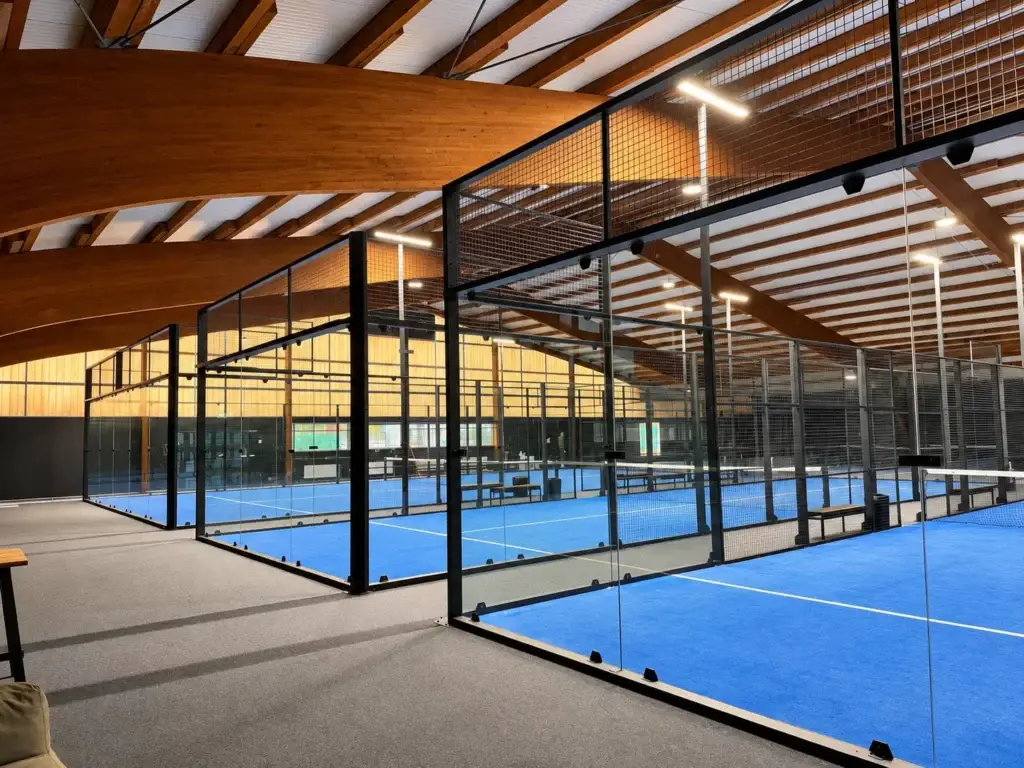
| Panoramic Pro | Indoor | High-occupancy commercial clubs, centre courts and event venues | Clear glass views make the court a stage for spectators, sponsors and streaming, which supports premium pricing. Reinforced frame and 12 mm tempered glass for heavy daily use. |
| PREMIUM-Line | Outdoor | Open-air clubs, resorts, and exposed or windy sites | Structural calculations to DIN and Eurocode wind loads. Hot-dip galvanisation available for tropical and coastal climates. Built to last outdoors. |
Planning permission, noise and floodlighting in the UK and Ireland
In the UK and Ireland, the court itself is rarely the hard part. Getting the site approved is. Most delays, and surprise costs, come from four areas:

Planning permission
Outdoor courts with glass walls, fencing or a canopy usually need planning consent from your local council in the UK, or your local authority in Ireland. For indoor clubs, check whether your building already allows sport and leisure use: a change of use can add months to the timeline. See our hall requirements for indoor padel.

Noise
Padel is louder than tennis, and councils know it. Expect to be asked for a noise impact assessment if neighbours are close. Site layout, acoustic barriers and opening hours often decide whether a scheme gets approved. More on noise emission values in padel.
Floodlighting
Evening slots carry much of the revenue, but lighting needs approval too. Councils typically look at light spill, glare and operating hours: see controlling light emissions.

Structure and foundations
Our courts are designed to DIN and Eurocode wind loads, but your project still needs to meet the local National Annex and site conditions, confirmed by your structural engineer.
Read more on padel court foundations.
Our advice
Speak to your council’s planning team and an acoustic consultant early, before you commit to a site
The right site saves more money than any discount on the courts.
How to open your padel club: next steps
Measure your space
Get the dimensions or a layout plan of your building or plot.
Plan the layout
Use the Padel Floor Planner to see how many courts and extra areas (lounge, bar, shop) fit.
Check planning
Talk to your council and consultants about what your site needs.
Run the numbers
Test break-even with the formula above, the Profit Calculator and the Business Plan.
Get a quote
Request a quote tailored to your site and the right court line.
Looking for funding or partners? Find out who invests in padel.
Conclusion
Padel demand is strong, and in many markets players still struggle to get a court at peak times. The most successful clubs aren’t the ones with the most courts. They fill every court-hour at the right price and give players a reason to come back: easy booking, well-kept courts, good lighting, coaching, social events and a place to stay after the match. A great player experience turns one-off bookings into regulars and members, and steady regulars are what make a club profitable.
Think about your site, permits, court line and operations together from day one, and your investment has the best chance of paying back quickly.
Ready to run the numbers? Speak with us.