

A padel club makes money from court hire first, and then from everything that happens around the court: coaching, leagues and events, food and drink, equipment and memberships. Strong clubs don’t rely on one stream. They keep their courts full, charge the right price at the right time, and give players reasons to stay and spend once they’re on site.
Here’s where the income comes from, what the best-performing clubs do differently and why padel works so well for tennis clubs and sports venues.
Where the money comes from
| Revenue stream | How it works |
|---|---|
| Court hire | The core income. Prices usually vary by time of day, day of the week and booking length, so peak slots earn more. |
| Coaching and academies | Group sessions, private lessons and junior programmes. Tennis coaches can add padel to their existing offer. |
| Leagues, tournaments and social events | Ladders, socials and competitions fill quieter slots and turn one-off players into regulars. |
| Memberships | Where it suits the venue, memberships give players booking priority and the club a steady monthly income. |
| Food and drink | Players who stay after a match spend more. A bar or café also makes the club a place to meet. |
| Equipment sales and rental | Rackets, balls and accessories for newcomers who don’t own kit yet. |
| Sponsorship and advertising | Custom nets and vinyls with sponsor branding give local businesses visible space on court. |
What top-performing clubs do differently
The gap between strong and weak clubs is large. According to the Playtomic Global Padel Report 2026, the top-performing commercial clubs earn around €3,531 in booking revenue per court per month, against €736 for clubs at the lower end: roughly five times more (p. 35). These are global figures, and both groups operate side by side in the same markets.
€3,531
Booking revenue per court per month, top-performing clubs
€736
Booking revenue per court per month, lower-end clubs
~5×
The gap between the two groups
The report finds no single lever behind that gap. Top clubs do better across the whole operation: how often courts are used, pricing, the mix of activities, online booking and the quality of the facility (p. 35). Three patterns stand out:

They sell more than court time
About 9 in 10 top-performing clubs offer experiences beyond the court. Social events (around 74%) and instructor-led activities such as group coaching and fitness classes (around 72%) are the most common, followed by facility and wellness access (around 56%) and extras such as video recording or racket rental (around 38%) (p. 37).

Social events are a steady earner
Around 45% of surveyed clubs rely on social events as a regular contributor, worth 10–25% of their income (p. 38).

Indoor and covered courts reduce seasonality
They keep demand stable through the year and support stronger pricing (p. 30).
Why padel is good business for UK venues
Demand in the UK is running ahead of supply. The same report puts average peak-hour occupancy at major UK clubs at around 85%, and about half of UK players say they struggle to book a court at peak times (p. 16). UK clubs are also building dedicated fitness communities around padel (p. 39), which opens the door to classes and memberships beyond court hire.
Why padel suits tennis clubs and sports venues
More paying players per square metre
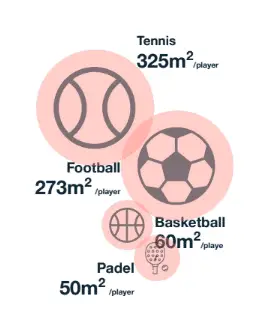
Padel uses space efficiently. Each paying player needs about 50 m², compared with 60 m² for basketball, 273 m² for football and 325 m² for tennis.
| Sport | Space per player |
|---|---|
| Padel | ~50 m² |
| Basketball | ~60 m² |
| Football | ~273 m² |
| Tennis | ~325 m² |
One tennis court, two or three padel courts
A padel court measures 20 × 10 m, so a single tennis court can usually be converted into two or three padel courts. You can test layouts for your site with our floor plans for padel clubs.
Easy to learn, so new players come back
Beginners need only 5–10 minutes of introduction before they can play a real game. Quick early success is what brings them back, and every regular player is repeat income.
A new offer for your coaches
Tennis coaches can broaden their programme with padel courses and attend specialised workshops to get started.
Fewer members leaving
Members leave clubs mainly because the fun fades, because they switch to another sport or because the membership structure no longer suits them. Rarely is it about price. Padel gives existing members something new to play and attracts new, often younger, members to the club.
Download the padel planning spreadsheet
Want to run the numbers yourself? Our Excel planning spreadsheet helps you map out the income and costs of a padel club for your own site.
- Contact us by email to request your free access code.
- Enter the code below to unlock the download.
Plan your numbers
Before you invest, put the figures together for your own site:
- Business Plan for Padel: how to structure your plan
- Profit calculator: estimate income for your number of courts
- Is a padel club profitable in 2027?: the investment case
- Global Padel Report: market data in more detail