

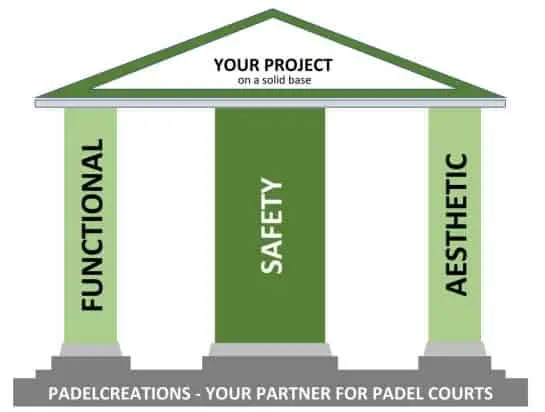
A great padel court does three jobs at once: it keeps players safe, it plays true shot after shot, and it looks good enough to fill your booking sheet. Get one wrong and the other two suffer.
Whether you run a club, a hotel, a leisure centre or you’re building a private court at home, the decisions are the same. Below we walk through what to check on safety, playability and design, based on our experience manufacturing and installing courts across Europe.
Safety first: what a safe padel court is made of
Padel is fast and physical. Players run into walls, lean on the mesh and dive for balls near the posts. Every component has to be built for that.
A structure engineered for real loads
The steel frame carries the glass, the mesh and the lighting, and it has to withstand wind as well as impacts. Look for hot-dip galvanised steel with a polyester powder coating, which protects against corrosion outdoors and in humid indoor halls. Anchoring matters just as much: the posts must be fixed to a level, properly designed concrete slab, not to a surface that will shift.


Tempered safety glass
The back and side walls are usually 10 mm or 12 mm tempered glass. In the EU, tempered safety glass is covered by EN 12150-1. If it ever breaks, it shatters into small, blunt fragments rather than sharp shards. Glass fixings should be flush, with no protruding bolt heads on the playing side.
A surface that grips without gripping too much
Artificial turf with silica sand infill gives traction and controls ball bounce. Too little sand and players slip; too much and knees and ankles take the strain on quick turns. Even sand distribution is part of regular maintenance, not a one-off job.
Lighting that removes shadows and glare
Good lighting is a safety feature, not just a comfort one. Uniform light levels mean players can track the ball off the glass without blind spots. LED floodlights mounted on the structure should be aimed so they don’t dazzle players looking up for a lob. European sports lighting is covered by EN 12193.
Standards to ask your supplier about
The Spanish standard UNE 147301 sets out requirements for padel courts and is widely used as a reference. An international standard, ISO 25808 (padel court safety requirements and inspection methods), is currently in development, building on that Spanish work. Ask any manufacturer which standards their courts are designed and tested to, and request the documentation.
Functional: a court that plays properly, season after season
A safe court that plays badly won’t keep members coming back. Functionality comes down to dimensions, bounce and how the court copes with weather and heavy use.
The right dimensions and space
| Typical specification | Typical specification |
|---|---|
| Playing area (doubles) | 20 m x 10 m (interior) |
| Back walls | 3 m glass + 1 m mesh = 4 m |
| Side walls | Stepped glass and mesh, per regulation |
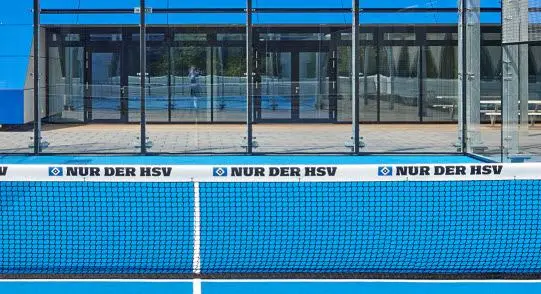
| Net height | 88 cm centre, 92 cm at the posts |
| Clear height indoors | 6 m minimum; 8 m or more recommended for competition |
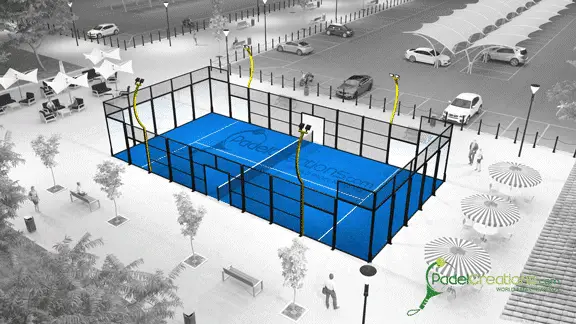
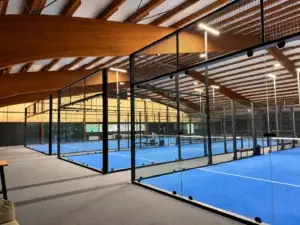
Panoramic courts reduce the number of posts behind the glass, giving players more room on the sides and a clearer view for spectators.
Consistent bounce off glass and turf
Ball rebound off the glass should be predictable along the whole wall. That depends on glass thickness, rigid fixing and a frame that doesn’t flex. On the floor, the turf type (fibrillated or monofilament) and sand level determine how fast and true the ball bounces.
Drainage and weather resistance
Outdoor courts in the UK and Ireland face a lot of rain. A slab with the correct slope and permeable or drained turf keeps the court playable soon after a shower. Galvanised, coated steel and stainless fixings stop rust from shortening the court’s life.
Low, predictable maintenance
A functional court is easy to look after. Plan for regular brushing and sand top-ups, periodic checks of bolts, glass fixings and door hinges, and lighting inspections. Well-built courts need small, routine care rather than costly repairs.
Design: courts that look as good as they play
Design is where your court becomes part of your venue’s identity. The best designs never compromise safety or play; they build on top of them.
Choose the right model
- Standard courts: a proven, cost-effective option for clubs and community sites.
- Panoramic courts: minimal posts and maximum glass for a premium look and better spectator views.
- Super-panoramic and showcourts: for venues that host events, film matches or want a flagship court.
- Portable or demountable courts: ideal for temporary installations, events or sites where planning is a concern.
Colours and finishes
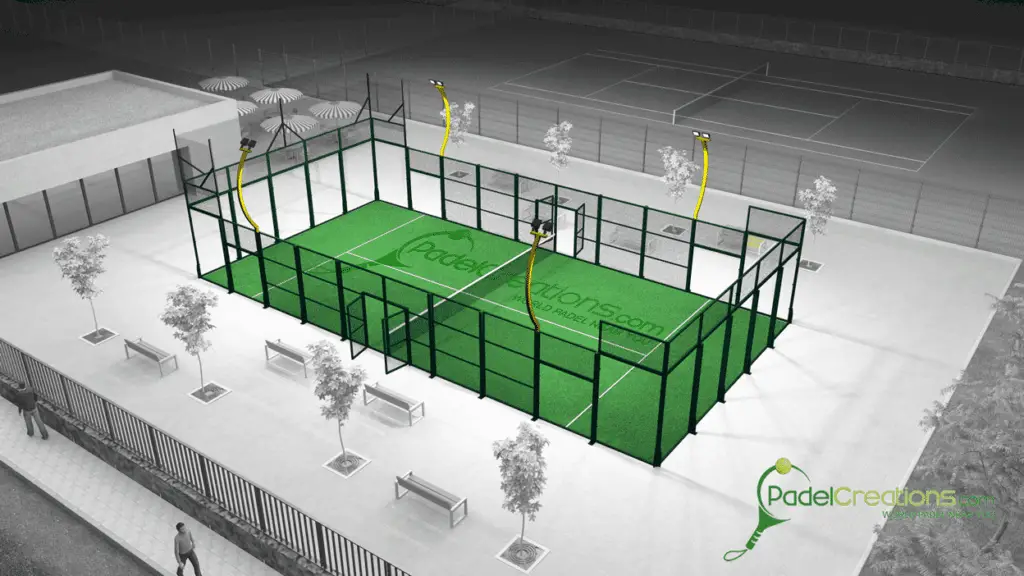
Structure colour and turf colour change the whole feel of a court. Classic blue or green turf suits most venues, while custom colours can match a hotel, resort or brand palette. Stick to colours that keep a strong contrast with the yellow ball.
Branding and integration
Vinyl graphics on glass, branded windscreens and custom post caps turn a court into a marketing asset. Think about how the court fits its surroundings too: a rooftop, a garden or a sports hall each calls for different lighting, colours and access.
Build your court with PadelCreations
At PadelCreations we design, manufacture and install padel courts that put safety and playability first, then add the design touches that make your venue stand out. Tell us about your site and we’ll recommend the right model, surface and lighting.