


Padel Court Lighting Standards: what you need to know before you build
Most people think about the court surface, the glass panels, the fencing. Lighting is usually an afterthought — until the first evening session, when the ball becomes a blur and players start complaining. Getting illumination right from the start is one of those decisions that quietly defines whether a padel facility thrives or frustrates.
This guide covers the European standard that governs padel court lighting, what the numbers actually mean in practice, and how to choose the right LED setup for your project — whether you’re building a single recreational court or a multi-court club.
The Standard That Applies: EN 12193
Padel courts follow the same lighting standard as tennis: EN 12193, the European Standard for Sports Lighting. Published by CEN (European Committee for Standardisation), it sets out minimum requirements for illuminance, uniformity, and glare control across a wide range of sports facilities.
The goal isn’t just brightness. EN 12193 is about creating conditions where players can track a fast-moving ball reliably, react in time, and play without visual fatigue. At a competitive level, it also accounts for spectators — and for televised matches, separate broadcasting requirements apply on top of these baseline figures.
For padel specifically, the standard defines three lighting classes tied to the level of play.
To put those numbers in context: in a DIALux-verified simulation using
professional 240W asymmetric LED fixtures, 4 units per court achieve a
maintained average of 303 lx with 0.70 uniformity — comfortably meeting Class III outdoor requirements. Eight units of the same fixture deliver 606 lx at the same uniformity, satisfying Class II indoor requirements with margin to account for lumen depreciation over time.
The Three Lighting Classes
Class I — National and International Competition
This covers top-level tournaments that draw significant crowds but are not broadcast on television. Think major national championships or international club events. Illuminance requirements are high, and the lighting design needs to account for spectators at potentially long viewing distances.
For most club and leisure projects, Class I isn’t necessary. But if you’re building a flagship venue or future-proofing for competitive use, it’s worth knowing the spec from the outset.
Class II — Regional and Club Tournaments
The middle tier covers regional competitions, local league play, and high-level training. If you’re building a padel centre that will host regular club nights and occasional tournaments, Class II is typically your target. It’s the level at which the game feels properly lit — players aren’t squinting, shadows don’t interfere with play, and the whole experience feels professional without over-engineering the installation.
Class III — Recreational Play and General Training
This is the baseline for casual sessions, beginner coaching, school sport, and low-key club matches with few or no spectators. Class III illuminance is perfectly adequate for the vast majority of recreational courts — and given the lux levels involved, it’s still a significant amount of light, not a dim alternative.
The key point: many club operators choose to install to Class II or even design with Class I in mind, not because competition demands it, but because players notice the difference. Better light = better experience = more bookings.
Minimum Illuminance Requirements (EN 12193:2008)
The table below shows the minimum horizontal illuminance values required for each class, split by outdoor and indoor installation:
Lighting class | Horizontal illuminance | ||
| Illuminance (lux) | Uniformity | ||
| OUTDOOR | INDOOR (*) | ||
| I | 500 | 750 | 0,7 |
| II | 300 | 500 | 0,7 |
| III | 200 | 300 | 0,5 |
A few things worth unpacking here.
Lux is not just about raw brightness. Uniformity — the Uo figure — matters just as much. A uniformity ratio of 0.7 means the dimmest point on the court must be at least 70% as bright as the average. In practice, this eliminates harsh shadows and hotspots. Uneven lighting forces your eyes to constantly re-adjust as the ball moves from a bright zone to a darker one. Over the course of an evening session, that’s exhausting in a way players feel but can’t always articulate.
Indoor courts generally require higher lux values. The reason is simple: artificial light is the only light source. Outdoor courts can benefit from ambient light conditions in some circumstances, but indoor facilities need to generate the full illuminance from scratch — and reflections off walls and ceilings can complicate how light behaves in enclosed spaces.
For further questions just get back to us. To the contact form click here.
See also Lighting System on Padel Courts
Outdoor Courts: Floodlights Done Right
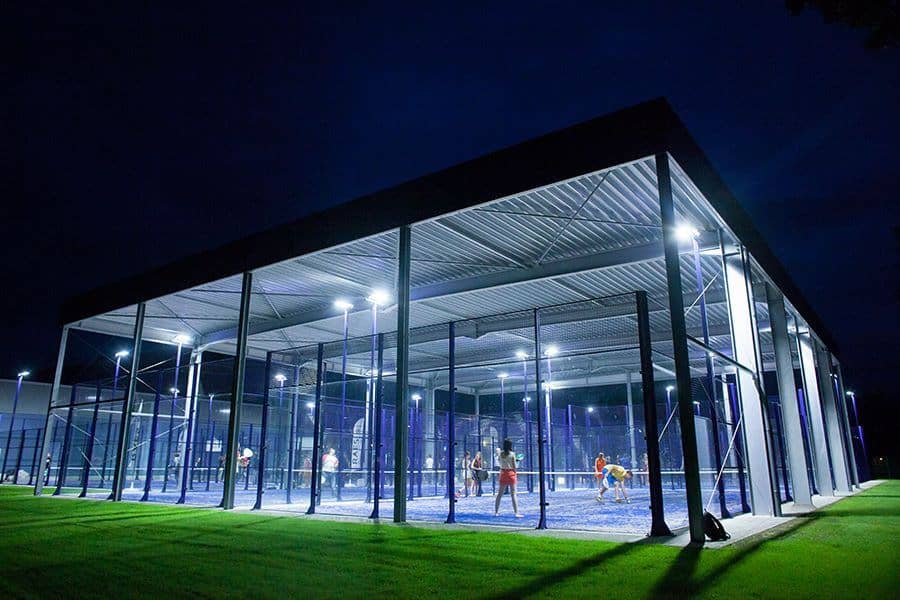
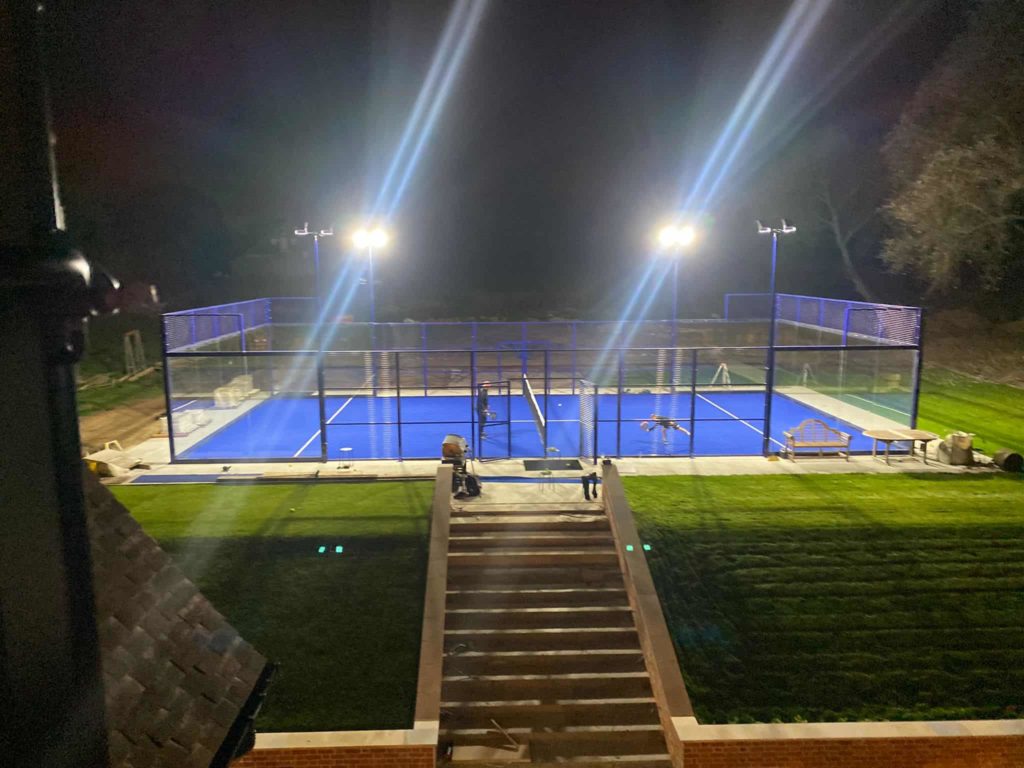
For outdoor padel courts, LED floodlights mounted on columns or the court structure are the standard solution. The key variables are mounting height, beam angle, the number of fixtures, and their positioning relative to the court.
A well-designed outdoor lighting scheme achieves the required lux level across the playing area while minimising spill light — the light that escapes the court boundary and affects neighbouring properties. EN 12193 addresses this directly: limiting spill light is an explicit requirement, not just a courtesy. For planning applications in the UK and Ireland, this is increasingly scrutinised by local authorities.
Column height matters. Too low, and you create glare that shines directly into players’ eyes at certain positions on court. Too high without appropriate beam angles, and you lose efficiency. A proper photometric study — a lighting report that maps the expected illuminance across the court — is the only reliable way to confirm a design before installation.
We provide lighting reports as standard with our installations.
Indoor Courts: Using What’s Already There
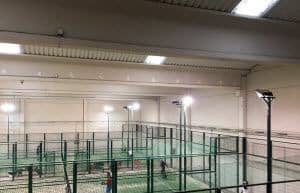
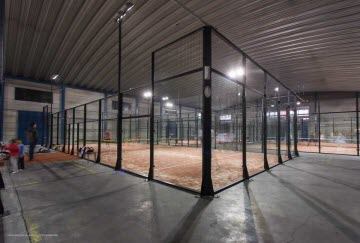
Indoor padel courts introduce a different set of considerations. Many facilities have existing hall lighting — high-bay fittings, industrial LED strips, or older metal halide systems — and the question is always whether that existing infrastructure is sufficient.
The short answer: sometimes, with additions.
Existing hall lighting can contribute to the overall lux level on a padel court, but the relationship between lumens (total light output) and lux (light per square metre) depends on factors like ceiling height, beam angle, and the position of the fittings relative to the playing area. You can’t simply add up lumen values and assume a proportional gain in lux.
Where hall lighting falls short, additional LED spotlights — mounted on the ceiling directly above the court, or integrated into the court structure itself — can bring illuminance up to the required level. Our LED fixtures are designed to complement existing hall lighting, and we can model the expected lux contribution based on your facility’s specific ceiling height and layout.
For enclosed indoor padel buildings, we handle the full lighting design as part of the court installation.
Why LED Is the Only Sensible Choice Now
If you’re looking at padel court lighting in 2025, LED isn’t really a choice — it’s just how it’s done. The performance and operational economics versus older metal halide or fluorescent systems aren’t close.
Efficiency. Modern LED floodlights produce significantly more lux per watt than their predecessors. For a four-court outdoor facility operating several hours every evening, that difference adds up to meaningful savings over a season.
Lifespan. Quality LED fixtures designed for sports lighting are rated at 50,000 hours or more. That’s well over a decade of regular use before you’re thinking about replacements.
Instant on. LED reaches full output immediately. Metal halide systems needed a warm-up period of several minutes — impractical for facilities where courts are booked back-to-back.
Controllability. LED systems can be dimmed, scheduled, and in some configurations controlled per-court. This is particularly useful for multi-court facilities where not every court is in use every hour.
Light quality. Colour rendering (CRI) affects how true colours appear under artificial light. High CRI LED fixtures make the ball and court surface look as they should — important for player experience, and increasingly expected at any facility with a serious reputation.
See also https://www.padelcreations.com/controlling-light-emissions/
LED Fixtures for Padel Courts: What the Specs Actually Mean
Not all LED floodlights work on a padel court. The glass walls, the overhead
shots, the uniformity requirements — they demand fixtures built specifically
for this sport. Here’s what to look for, and why each specification matters
in practice.
- High efficacy: 140+ lm/W: Fewer fixtures needed to reach the required
lux level, reducing both installation cost and pole loading. - Asymmetric beam (120° × 60°), adjustable tilt: Directs light across the court while controlling lateral spill. Critical for padel: standard symmetrical floodlights reflect off the glass panels and blind players on overhead shots. Asymmetric optics prevent this at the fixture level.
- 5,700K colour temperature, CRI >80: Neutral daylight-like white. Players perceive the ball, lines and court surface accurately. Low-CRI lighting makes the yellow-green padel ball harder to track.
- IP66, IK08, 6KV surge protection: IP66 handles outdoor rain and wind.IK08 withstands a direct racket or ball impact without cracking. Surge protection guards the driver electronics — the most common cause of premature LED failure in sports installations.
- Flicker-free driver : Eliminates the stroboscopic effect on a fast-moving ball, relevant for both player comfort and safety.
Dialux Results: what 4 vs 8 Fixtures deliver
Specifications on paper are one thing. Here’s what verified DIALux photometric
data shows for a professional 240W asymmetric LED fixture, calculated with a
maintenance factor of 0.80 — accounting for realistic lumen depreciation over
time.
| Configuration | Avg. lux | Emin | Emax | Uniformity | EN 12193 |
|---|---|---|---|---|---|
| 4 × 240W | 303 lx | 211 lx | 352 lx | 0.70 | Class III outdoor ✓ |
| 8 × 240W | 606 lx | 424 lx | 703 lx | 0.70 | Class II indoor ✓ |
What these numbers tell you:
- Both configurations hit 0.70 uniformity** — meeting EN 12193 for Classes
I and II. No dark corners, no bright hotspots. - 4 fixtures stay above 200 lx minimum** even after years of lumen
depreciation. The 211 lx floor gives real compliance headroom, not just
a pass on day one. - 8 fixtures exceed the 500 lx indoor threshold with margin — important for a facility that needs to perform in five years, not just at commissioning.
Note: these results apply to a single outdoor court simulation. Indoor results vary depending on ceiling height and existing hall lighting.
Practical Guidance for Court Owners and Investors
A few things worth keeping in mind before you commit to a design:
- Start above the minimum.: Class III is compliant on paper, but players
notice the difference. If you’re targeting evening bookings, Class II
illuminance keeps them coming back. - Get a photometric report before installation: It maps the actual lux distribution for your specific fixtures, mounting height and layout — and it’s the documentation you need for planning applications in the UK and Ireland. We provide this as standard with every installation.
- Factor in lumen depreciation: A design that barely meets EN 12193 at commissioning will fall short within a few years. Specify with a maintenance factor of 0.80 to ensure long-term compliance.
- Energy costs compound: For a six-court facility running 2,500 hours per year, the difference between a well-specified LED system and a cheap alternative adds up significantly over five to ten years.
- For a quick overview of standard setups and costs, see our padel court lighting guide https://www.padelcreations.com/lighting-system-on-a-paddle-court/
FAQ
For outdoor recreational courts, EN 12193 Class III sets a minimum of 200 lux with a uniformity ratio of 0.5. For indoor recreational courts, the minimum is 300 lux. Most club-level and commercial courts aim for Class II (300 lux outdoors / 500 lux indoors) to provide a comfortable playing experience.
There’s no universal answer — it depends on the mounting height, the fixture’s lumen output and beam angle, and the target illuminance class. A photometric study (lighting report) will determine the correct number and positioning for your specific installation.
Sometimes, with additions. Existing fittings can contribute to the overall
lux level, but ceiling height, beam angle and fixture position all affect
the result. Additional LED spotlights are usually needed to reach the
required uniformity across the court.
4,000K to 6,000K — neutral to cool white — with a CRI of 80 or above.
This ensures accurate colour rendering of the ball, court lines and player movement.
No, but it is now the industry standard. Metal halide systems remain
EN 12193 compliant if they meet the lux requirements, but they are rarely
specified in new builds due to higher running costs, slow warm-up time and shorter lifespan.
- Asymmetric optics (not standard flood optics)
- UGR below 19 for glare control
- CRI 80 or above
- IP66 minimum for outdoor use
- IK08 impact resistance
- Flicker-free driver