

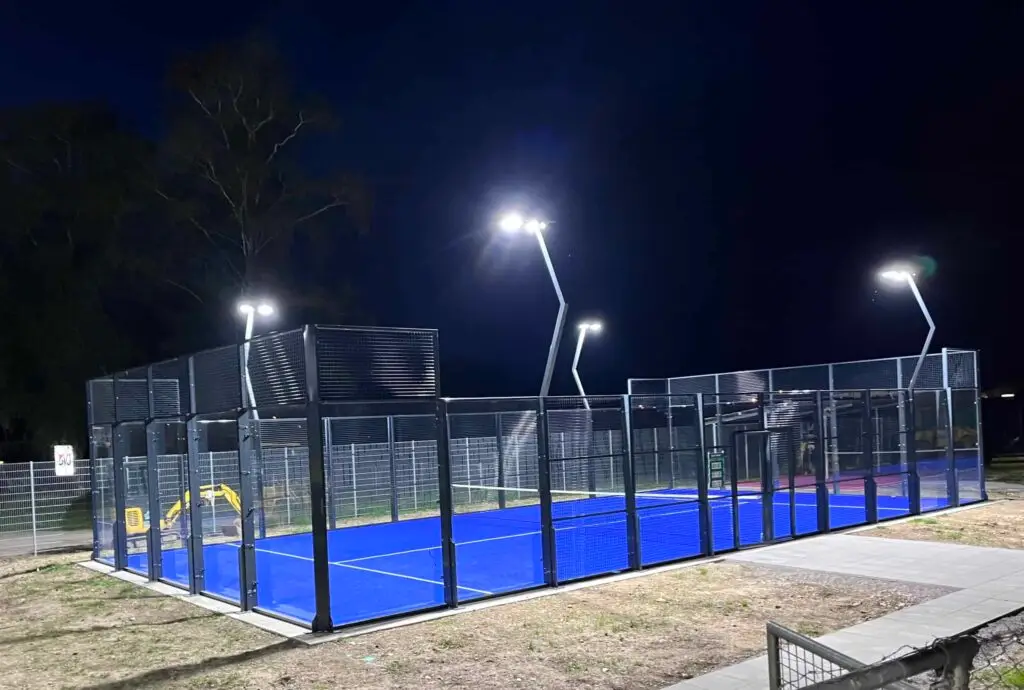
 | Good padel is played at night just as well as in the afternoon, but only with the right lighting. In central and northern Europe, daylight fades early for much of the year, and evenings are when most players want to book. A well-designed padel court lighting system turns those hours into revenue. Here’s how a modern LED lighting system for padel courts is set up: how much light you need, the masts and mounting height, the number of floodlights, the right colour temperature, and how to keep the light on the court and away from the neighbours. |
How much light does a padel court need?
The European standard EN 12193 (Light and lighting – Sports lighting) sets the light levels for sports facilities. It defines three classes depending on how the court is used. Indoor Padel Courts need more light than outdoor Padel Courts, because walls and ceilings make for a different viewing environment and players expect a brighter, more even light.
| Class | Use | Outdoor Padel Courts | Indoor Padel Courts |
|---|---|---|---|
| Class III | Recreational play and training | approx. 200 lux | approx. 300 lux |
| Class II | Club competition and performance training | approx. 300 lux | approx. 500 lux |
| Class I | Top-level competition and TV broadcasting | 500+ lux | 750+ lux |
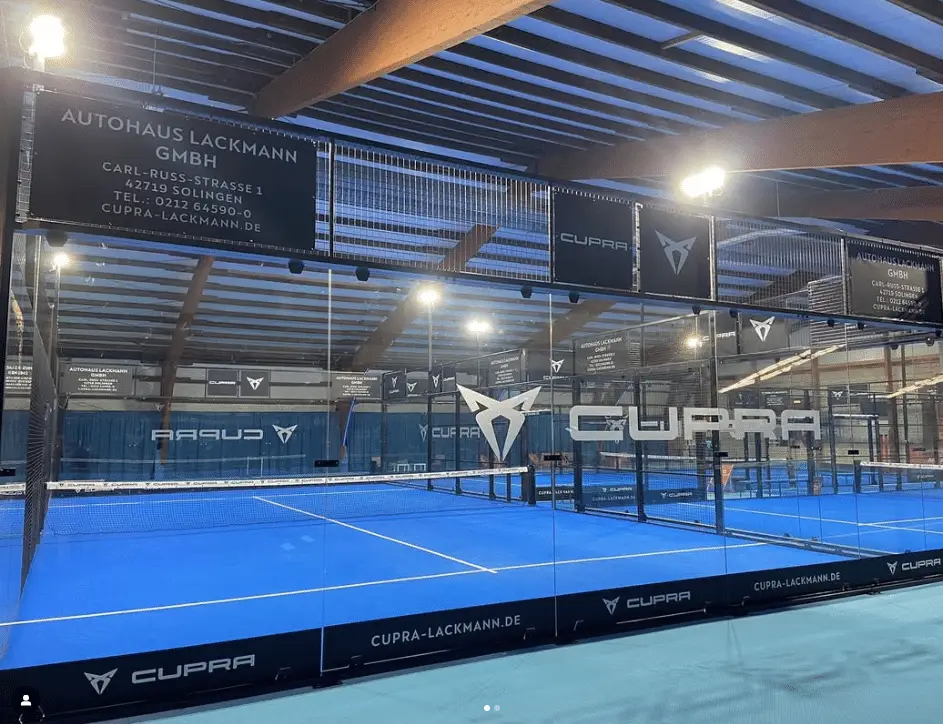
For most clubs, Class II is the right target: 300 lux outdoors or 500 lux indoors. It gives players a clearly visible ball and leaves you ready to host club tournaments.
The lux value alone isn’t enough. The light must also be even across the whole court, so players never lose the ball in a darker zone, especially near the glass walls and in the corners. EN 12193 sets requirements for this uniformity too; indoors, a uniformity of at least 0.7 is typical. A professional lighting plan shows both values for your court before you buy.
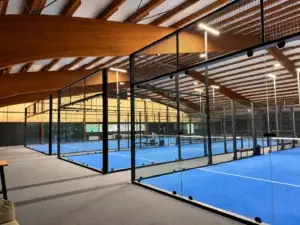
Indoor Padel Courts: floodlights mounted on the hall ceiling or roof structure must sit above the clear height of at least 6 m (ideally 8 m), never inside it. → [Indoor padel court height & hall requirements]
Colour temperature: 5,700 K as standard, 3,000 K on request
Colour temperature describes how “warm” or “cool” light looks, measured in Kelvin (K). Our floodlights come as standard with 5,700 K, a cool white light that gives players a crisp, bright view of the ball.
More and more councils are asking for warmer light of around 3,000 K, especially near homes, in rural areas and close to wildlife habitats. Warmer light contains less blue light, which:
- appears less glaring to neighbours
- has less impact on wildlife such as bats and insects
- fits better with “dark sky” policies
We also deliver our floodlights in 3,000 K. Players still get good ball visibility, provided the floodlights deliver the required lux level and a good colour rendering index (CRI above 80).
Our advice: check your council’s lighting requirements before you order. If your site is near homes, open countryside or protected habitats, plan with 3,000 K from the start, because changing floodlights after planning approval is costly.
Key benefits of the specialized LED floodlight
- Drastic stray light reduction — aligns with dark-sky principles.
- Smart dimming & control — adapts to usage, lowers impact and costs.
- Regulatory compliance — simplifies permits and neighbor relations.
- Long-term savings — reduced bills and maintenance.
| Pole height | Typical use | Floodlights per court | Benefits |
|---|---|---|---|
| 6 m | Recreational play and club use (Class III–II) | Outdoor Class 2: 4 Indoor Class 2: 8 | Even light, low glare, cost-effective |
| 6–8 m | Professional play and competition (Class I) | 12 | Better light distribution, suitable for streaming |
| 8 m+ | Televised events | Project-specific | Fewer shadows, more light on vertical surfaces for cameras |
Keeping light where it belongs
Neighbours notice stray light long before they notice noise. Light shining into gardens and bedrooms, or glare from floodlights seen from the street, is one of the most common reasons for complaints. It’s also something councils check in planning applications.
What councils look at
In the UK for example, councils usually assess obtrusive light against the Institution of Lighting Professionals (ILP) Guidance Note on the reduction of obtrusive light. It sets limits depending on how dark the surroundings are, from rural areas to town centres. The LTA’s guidance states that if homes are within 50 m of the Padel Courts, a lighting survey will likely be required, the same rule as for noise.
How to keep light on the Padel Court
- Full cut-off floodlights: no light is emitted above the horizontal, the requirement many authorities now set.
- Asymmetric floodlights: they direct the light down onto the court instead of spreading it in all directions.
- Mount the floodlights flat: with little or no tilt, so no light shines upwards or beyond the court.
- Shields and louvres: they block light towards neighbouring properties where needed.
- Dimming and switch-off times: dim the lights when a court isn’t booked, and switch them off automatically at the end of your operating hours, ideally linked to your booking system.
- Plan with a lighting design: a lighting plan shows how much light reaches neighbouring windows and gardens. Councils often ask for this with the planning application.
In existing halls, check the current lighting first. If it doesn’t reach the required level, LED floodlights can be added, based on a lighting calculation.
Maintenance of the lighting system
LED systems need very little maintenance, but a few checks keep them performing:
- Clean the floodlight covers once or twice a year
- Check the mast fixings and cable connections, especially after storms
- Measure light levels from time to time to make sure the court still meets its class
What affects the cost of a padel court lighting system?
Every project is different, so prices vary. The main factors are:
- The number of floodlights and the light class required
- Outdoor masts or indoor mounting
- Control and dimming options
- Electrical installation and cabling on site
- Planning requirements for light emissions
Light up your padel court with PadelCreations
Every PadelCreations court can be supplied with a complete LED lighting system, designed for its use and its surroundings. Tell us about your project and we’ll recommend the right setup.
Tell us about your project
we´ll recommend the right setup