

An outdoor padel court is essentially a 4-metre-high box of glass and steel standing in the open. When the wind picks up, those walls behave like sails. If the structure, fixings and foundations aren’t designed for it, the results can range from rattling panels to serious damage.
In the UK and Ireland, where storms and coastal winds are part of life, wind load is one of the most important factors in court design. Here’s what it means and how a well-built court handles it.

What is wind load?
Wind load is the force that moving air exerts on a structure. On a padel court it acts in two ways.
Pressure
Wind pushes directly against the glass walls on the side facing it.
Suction
On the opposite side and at the edges, the airflow creates negative pressure that pulls on panels and fixings.
Why padel courts are especially exposed
Glass walls are solid surfaces, so they catch the full force of the wind. Mesh lets some air through, but it still adds load. Add the weight of the floodlights at the top of the posts, and the structure has to resist significant bending forces at its base.To a structural engineer, a padel court is an unroofed, low-rise structure measuring 20 × 10 × 4 m. With around [108 m²] of glass, it gives the wind a large, solid surface to push against.
Factors that determine wind load on a padel court
Location and basic wind speed
Every region has a reference wind speed based on historical data. Courts in Scotland, the west of Ireland or on the coast face higher values than sheltered inland sites.
Terrain and exposure
Open terrain
Fields, beaches and rooftops offer no protection, so wind reaches the court at full strength.
Sheltered terrain
Buildings, trees and urban surroundings slow the wind down and reduce the load.
Height above ground
Wind speed increases with height. Rooftop courts and elevated sites need a stronger structural design than courts at ground level.
Court model
Panoramic courts use fewer posts behind the glass, so each post and fixing carries more load. The structure has to be engineered accordingly.
Standards for wind loads
In the UK, Ireland and the rest of Europe, wind actions on structures are calculated using Eurocode 1, EN 1991-1-4, together with each country’s National Annex. These set the wind speeds, terrain categories and safety factors to use for a given site.
Ask your supplier whether the court’s structure has been calculated to EN 1991-1-4 for your location, and request the structural documentation.

How a padel court is designed to resist wind
Steel structure
Post section and wall thickness
Posts and beams are sized to the calculated wind load. Higher-exposure sites call for larger sections or thicker steel.
Corrosion protection
Hot-dip galvanising and powder coating stop rust from weakening the structure over time, which matters even more in wet, coastal climates.
Glass and fixings
Tempered glass panels
10 mm or 12 mm tempered safety glass resists the pressure on each panel. Thicker glass adds stiffness on exposed sites.
Fixing system
The fixings transfer the load from the glass to the structure. They must be strong, evenly spaced and checked regularly so panels don’t loosen in storms.
Anchoring and foundations
Anchor bolts
Posts are bolted to the slab with anchors designed for the uplift and bending forces caused by wind.
Concrete slab and footings
The slab must be thick enough, and reinforced where needed, to hold the anchors. On high-wind sites, perimeter footings under the posts add extra resistance.
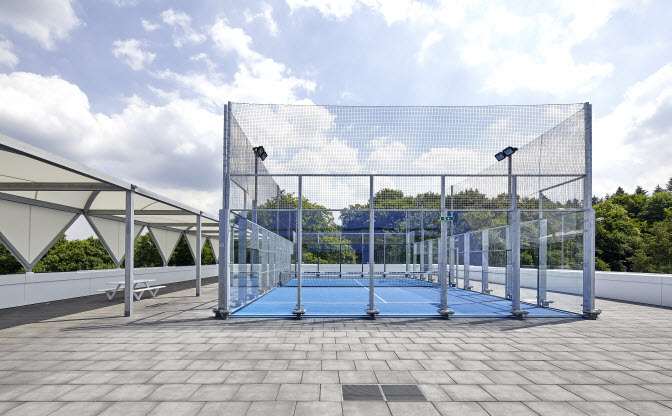
Rooftop and elevated courts
Courts on rooftops face stronger wind and need an engineer to check both the court structure and the roof’s ability to carry the loads.
Mod. PREMIUM: reinforced for exposed sites
We developed the Mod. PREMIUM for sites with high wind loads. An extra 80 × 80 mm external tube reinforces each post, making the structure particularly stable in strong wind. With our Structural Engineering Packages (SEP), it’s available in five strength classes and calculated to Eurocode.
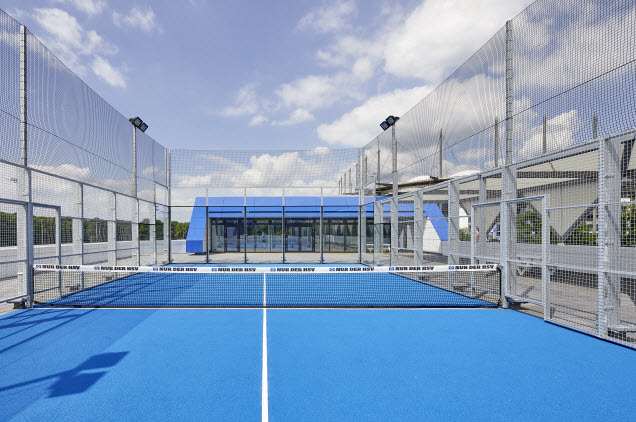
One example is our installation at HSV Hamburg: a Mod. PREMIUM PLUS in one of Germany’s windiest regions.
Indoor courts: no wind loads
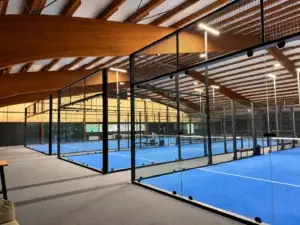
Inside a hall, there’s no wind load on the court, so the Mod. BASIC PRO is usually the right fit. That said, some operators still choose the Mod. PREMIUM indoors for the extra stability.
Wind and maintenance
- Check glass fixings and anchor bolts after every major storm
- Tighten any loose bolts and replace damaged fixings straight away
- Inspect windscreens and banners: they increase wind load and should be removable or designed for it
- Remove loose items around the court that could be blown into the glass