

Engineered to one of Europe’s strictest standards
German building regulations are known for their demanding requirements, and the German National Annex to the Eurocode sets wind-load rules that are stricter than the base Eurocode. Because the PREMIUM Line is designed and documented to this level, it gives you a robust structural basis wherever you build.
Building outside Germany?
We provide our structural calculation to the Eurocode. Your local structural engineer uses it as the basis to verify the court to your national code, a solid, well-documented starting point that saves time on your project. For high-wind regions, such as hurricane or cyclone zones, talk to us early so we can review your site together.
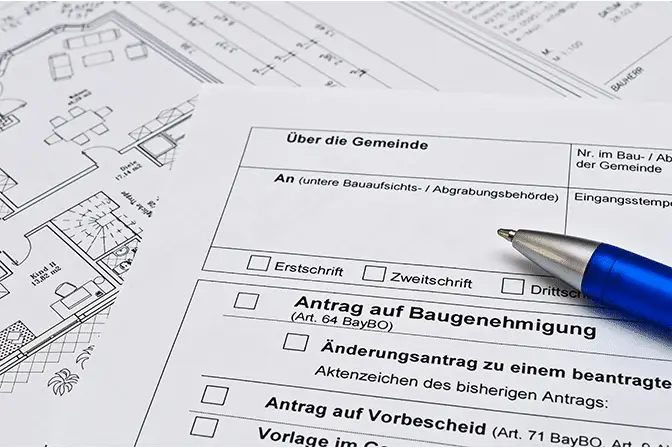
Building permit applications for padel courts are often delayed for one simple reason: the proof of structural stability is missing or incomplete. Building authorities need verifiable calculations that show the court can safely withstand wind and other loads at its specific location.
With our PREMIUM line, those calculations are part of the package.
Why structural stability matters for padel courts
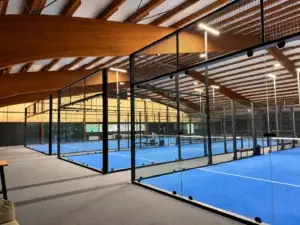
A padel court is a steel structure with large glass panels that stands in the open. That makes wind the most important load in its design. The glass walls catch the full force of the wind, and the posts and anchors have to carry it safely into the ground.
Without proper calculations, a permit may be delayed or refused, and, more importantly, the safety of players and spectators can’t be guaranteed. Find out more in our guide to wind loads on padel courts.
From Eurocode to German DIN: our PREMIUM line
Across Europe, structural loads are calculated using the Eurocodes. Each country adds its own National Annex, with values and requirements adapted to local conditions. In Germany, wind loads are calculated to DIN EN 1991-1-4 with the German National Annex, which sets stricter requirements than the base Eurocode.
Our Mod. PREMIUM padel courts now include structural calculations to DIN EN 1991-1-4 and its German National Annex. For you, that means:
- Verified structural stability for your court and your site
- Compliance with German building regulations
- Calculations in German, ready for the building authority
- Permit-ready documents that speed up the approval process
The four wind zones in Germany
Germany is divided into four wind zones, each with its own basic wind speed. The wind zone of your site determines the loads the court must withstand, and it’s one of the first things the building authority checks.
| Wind zone | Basic wind speed (vb,0) | Basic velocity pressure (qb) | Typical areas |
|---|---|---|---|
| Zone 1 | 22.5 m/s | 0.32 kN/m² | large parts of southern Germany |
| Zone 2 | 25.0 m/s | 0.39 kN/m² | much of central and northern Germany |
| Zone 3 | 27.5 m/s | 0.47 kN/m² | areas near the North Sea and Baltic coasts |
| Zone 4 | 30.0 m/s | 0.56 kN/m² | the North Sea coast and islands |
Values according to DIN EN 1991-1-4/NA. Height above ground and the surrounding terrain also affect the final loads.
Find out which wind zone in Germany your padel project is in
Support with your building permit
Our team helps you prepare the structural documents for your planning application and provides site-specific proof of stability for your padel court. That way, your project moves from planning to construction faster.